

Football isn’t played in straight lines.
A player might sprint five metres before suddenly stopping, changing direction, reacting to an opponent and accelerating into space. That’s why football agility drills can be useful for developing the movement skills that actually appear during a match.
Agility isn’t simply about being able to run quickly. It involves acceleration, deceleration, balance, coordination and the ability to change direction efficiently.
The good news is that you don’t need a professional training facility to work on these qualities. A small amount of space, a few cones and some consistency can be enough to build a useful agility session.
Quick answer: The most effective football agility drills combine changes of direction, acceleration, deceleration and reaction. Start with controlled movements such as lateral shuffles and cone drills before progressing towards reactive exercises that require you to respond to a stimulus.
What you’ll need
You don’t need much equipment to get started.
A basic session can be completed with:
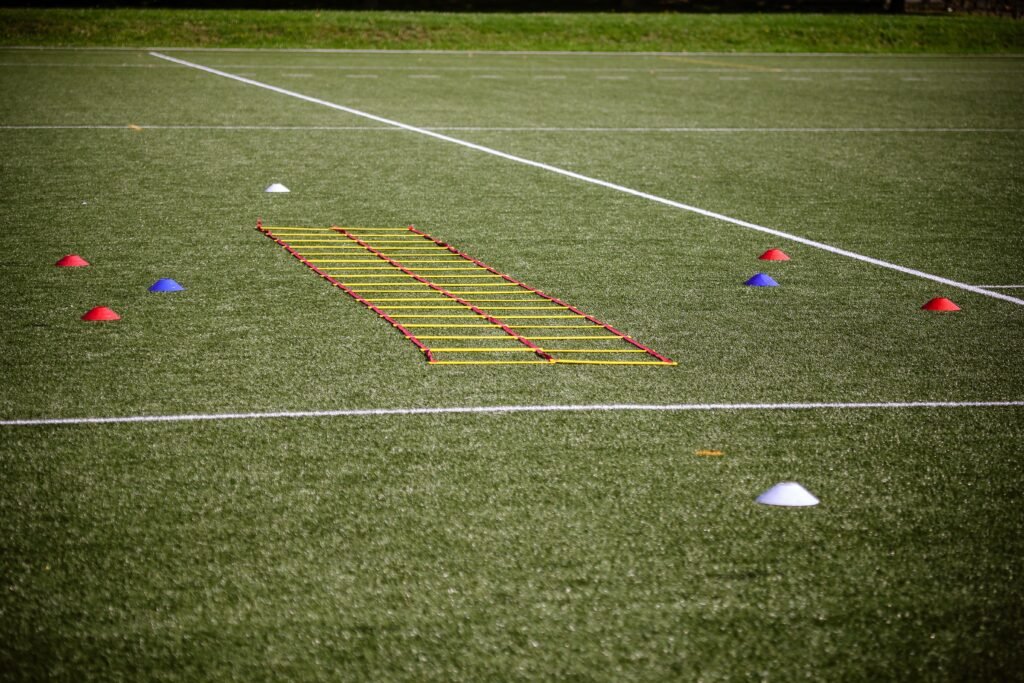
- 4–6 training cones
- An agility ladder
- A football
- Around 10–20 metres of space
- Appropriate football boots or training shoes
A set of cones is particularly useful because you can create dozens of different drills without needing specialist equipment.
You can grab a lot of cheap cones on amazon, they are just cones at the end of the day, no need for a fancy set up.
An agility ladder can also be useful for developing footwork and coordination, although it shouldn’t become the entire focus of your agility training.
If you are after an agility ladder you can check out this budget ladder from amazon, again, there is no need for an expensive set up here.
Why Agility Matters in Football
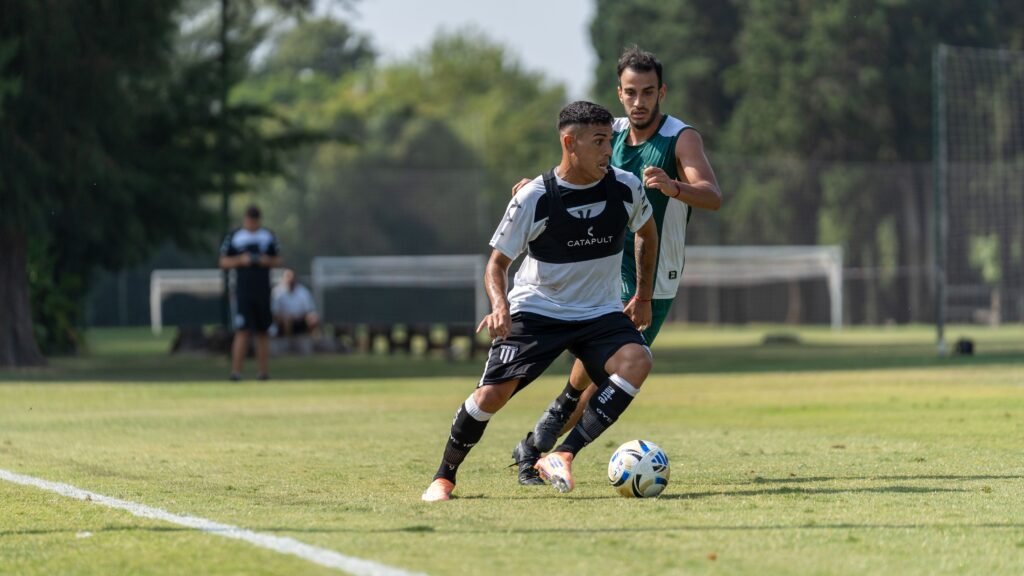
Football requires players to repeatedly accelerate, slow down and change direction.
A winger beating a defender, a midfielder turning away from pressure and a defender adjusting their position are all examples of movements that require more than simply straight-line speed.
Good agility can help a player:
- Change direction more efficiently
- Control their body when accelerating and decelerating
- React to opponents
- Improve coordination
- Move into space more effectively
- Develop confidence when changing direction at speed
However, it’s important to remember that agility isn’t just fancy footwork.
A player can be extremely quick through an agility ladder but still struggle to react to an opponent during a match.
That’s why a good programme should eventually progress from pre-planned drills to reactive movements.
10 Football Agility Drills to Try
1. Lateral Shuffle
The lateral shuffle is a simple starting point for working on sideways movement.
Set up two cones approximately 3–5 metres apart.
Start at one cone and shuffle sideways towards the other. Keep your knees slightly bent and try to remain balanced rather than crossing your feet.
Then shuffle back.
Try:
3 sets of 20–30 seconds
Focus on:
- Staying low
- Keeping your chest controlled
- Taking quick steps
- Avoiding unnecessary movement
As you become comfortable, increase the speed rather than immediately increasing the distance.
2. 5-10-5 Shuttle
The 5-10-5 shuttle is one of the more useful football agility drills for practising acceleration and changes of direction.
Set up three cones in a straight line:
Cone A — 5 yards — Cone B — 5 yards — Cone C
Start at the middle cone.
Sprint towards one outside cone, touch the line, change direction and sprint across the middle towards the opposite cone.
Finally, change direction again and finish at the middle.
The important part isn’t simply running as fast as possible.
Pay attention to how you decelerate before changing direction.
3. T-Drill
The T-drill introduces forward, lateral and backward movement.
Set up four cones in a T shape.
Start at the bottom of the T and sprint forward towards the centre.
From there, move laterally towards one side before travelling across to the other side.
Return to the centre and then move backwards towards your starting position.
Focus on:
- Controlled deceleration
- Quick changes of direction
- Staying balanced
- Maintaining good body position
This is a useful progression from simpler shuttle exercises.
4. Box Drill
Set up four cones in a square.
Sprint forward to the next cone, shuffle sideways, move backwards and then shuffle across the final side.
This introduces several different movement patterns within one drill.
Once you’ve mastered the basic version, you can change the direction or add a football.
Check out the current price on budget cones.
5. In-and-Out Agility Ladder
Place an agility ladder on the ground.
Move through it by placing both feet inside each square before progressing to the next one.
Once comfortable, experiment with:
- One foot per square
- Two feet per square
- Lateral movement
- Forward and backward movement
- Different step patterns
Don’t worry about trying to move as quickly as possible straight away.
Accuracy first. Speed second.
6. Lateral Ladder Shuffle
Turn sideways to the agility ladder and move through it laterally.
Place both feet into each square before moving to the next.
This can be useful for developing coordination and lateral footwork.
Try to keep your upper body relatively controlled while your feet move quickly.
A simple progression
Beginner: Walk through the pattern.
Intermediate: Increase foot speed.
Advanced: Add a reaction or sprint at the end.
7. Cone Zig-Zag Drill
Place 5–6 cones in a zig-zag pattern.
Sprint towards the first cone, decelerate, change direction and accelerate towards the next.
Continue through the entire course.
This is one of the easiest football agility exercises to adapt.
You can make it:
- Shorter and faster
- Longer and more demanding
- Ball-based
- Reactive
- Competitive with a training partner
The key is to avoid simply turning around the cones without controlling your body.
8. Sprint, Stop and Turn
Set up a cone approximately 10 metres away.
Sprint towards it.
As you approach the cone, gradually reduce your speed, come under control and then turn back towards the starting point.
This may look simple, but deceleration is an important part of changing direction.
Players often focus heavily on acceleration and overlook the ability to slow down effectively.
Practising controlled stopping can therefore be just as valuable as practising the sprint itself.
9. Reaction Cone Drill
This is where your agility training starts becoming more football-specific.
Set up three or four cones.
Have a training partner call out a colour, number or direction.
You react to their instruction and sprint towards the appropriate cone.
For example:
“Blue!”
You immediately accelerate towards the blue cone.
The major difference here is that you’re no longer simply memorising a movement pattern.
You’re reacting to information.
That makes the drill more representative of the demands of football.
10. Reactive Ball Drill
Take the previous drill and add a football.
Your partner can point towards a cone or give you a verbal instruction.
You react, move towards the cone and then receive a pass.
Alternatively, start with the ball and react to your partner’s movement.
This introduces:
Reaction → movement → ball control
rather than simply:
Movement → movement → movement
That’s an important distinction.
Football agility ultimately needs to transfer to football.
How to Build a Football Agility Session

You don’t need to perform all 10 drills in one session.
In fact, doing so could make the session unnecessarily long.
Instead, try combining different types of movement.
Example 25-minute session
Warm-up — 5 minutes
Light jogging, dynamic movements and gradual acceleration.
Movement preparation — 5 minutes
- Lateral shuffles
- Ladder work
- Controlled changes of direction
Agility — 10 minutes
Choose 2–3:
- 5-10-5 shuttle
- Zig-zag cone drill
- T-drill
- Box drill
Reactive work — 5 minutes
Finish with:
- Reaction cone drill
- Reactive ball drill
This gives you a mixture of planned movement and reaction-based agility.
How Often Should You Do Agility Training?
You don’t necessarily need to perform dedicated football agility drills every day.
Agility work is relatively demanding because you’re repeatedly accelerating, braking and changing direction.
For many recreational players, 1–2 dedicated sessions per week can be a reasonable starting point, depending on their existing football and strength training schedule.
You can also incorporate short agility blocks into normal training rather than creating an entirely separate session.
For example:
Warm-up → agility → technical work → small-sided game
This can be more practical for footballers who already have a busy training schedule.
Common Mistakes
Only Training in Straight Lines
Straight-line sprinting is valuable, but football rarely requires players to sprint continuously in one direction.
Include lateral and multidirectional movement.
Going Too Fast Too Soon
If your technique breaks down, you’re probably moving faster than you can control.
Build the movement first.
Ignoring Deceleration
Being able to stop and change direction is just as important as accelerating.
Making Every Drill Pre-Planned
Cone drills are useful, but eventually introduce reaction-based exercises.
Spending the Entire Session on an Agility Ladder
Ladders can help with coordination and footwork, but they aren’t a complete measure of football agility.
Forgetting the Ball
Agility without the ball is useful.
But football is played with the ball.
Once you’ve developed the basic movement, try incorporating it into technical drills.
Recommended Equipment
You can perform most of these drills with very little equipment.
Training cones
Probably the most useful purchase.
They’re cheap, portable and allow you to create a huge number of drills.
Agility ladder
Useful for footwork and coordination exercises.
Resistance bands
Resistance bands can be useful as part of a broader football strength and conditioning programme, particularly for exercises targeting the hips and lower body.
They’re not essential for agility drills themselves, but can complement your training.
Football
Once you’ve developed basic movement skills, adding the ball makes your training more representative of football.
What Does the Science Say About Agility Training?
There is an important distinction between change-of-direction speed and true agility.
A planned cone drill primarily tests your ability to change direction.
True agility also involves reacting to an external stimulus, such as an opponent, teammate or the movement of the ball.
Research in team sports has therefore increasingly looked at reactive and perceptual elements rather than treating agility as purely physical.
This is one reason a footballer shouldn’t rely exclusively on predetermined ladder and cone patterns.
A good progression is:
Basic movement
↓
Planned change of direction
↓
Faster change of direction
↓
Reactive movement
↓
Football-specific decision making
The final stages are arguably the most important if the goal is to transfer your training onto the pitch.
Football Agility Drills vs Speed Training
The two overlap, but they’re not identical.
Speed training
Primarily focuses on how quickly you can accelerate or sprint.
Agility training
Adds changes of direction, braking and potentially reaction.
A footballer benefits from both.
For example, a winger may need to sprint into space but then immediately slow down, cut inside and accelerate again.
That requires more than straight-line speed.
If you’re interested in developing the other side of your athletic performance, see our guide to [Strength Training for Football].
FAQs
What are the best football agility drills for beginners?
Start with simple movements such as lateral shuffles, cone zig-zags and basic shuttle runs. Focus on control and technique before increasing speed.
How often should footballers do agility drills?
One or two dedicated sessions per week can be enough for many recreational players, although agility work can also be incorporated into normal football training.
Can agility drills make you faster?
They can help develop acceleration, coordination and change-of-direction ability. However, agility training shouldn’t completely replace dedicated sprint and strength training.
Are agility ladders good for footballers?
They can be useful for coordination and footwork, but an agility ladder shouldn’t be treated as a complete agility programme. Combine ladder work with acceleration, deceleration, changes of direction and reactive drills.
Can I do football agility drills at home?
Yes. You only need a small amount of space and a few cones for many drills. Always make sure the surface is suitable and that you have enough room to slow down safely.
Should I do agility drills before or after football training?
If agility is a major training goal, performing it when you’re relatively fresh can help you maintain movement quality. Shorter agility drills can also be incorporated into a warm-up or training session.
Related Articles
I’d link this article naturally to your existing content rather than creating a huge list of affiliate posts.
Strength Training for Football
Useful for developing the physical qualities that support acceleration and changes of direction.
Resistance Band Exercises for Footballers
A natural equipment-related link from the recommended products section.
Exercises for Patellar Tendonitis: A Footballer’s Guide to Recovery
Relevant if you’re discussing the importance of managing training load and returning to movement after injury.
MCL Strain Recovery: A Footballer’s Guide
Another relevant recovery resource.
How to Gain Confidence in Football: A Science-Based Guide to Performing Under Pressure
A useful link when discussing decision-making and reacting to opponents.
Conclusion
Good football agility drills aren’t about seeing how quickly you can run through an agility ladder.
Football requires you to accelerate, decelerate, change direction, maintain balance and react to what is happening around you.
Start with controlled cone and footwork exercises, then gradually introduce faster changes of direction and reactive drills. Finally, bring the football into your sessions so that the movement becomes more representative of what actually happens during a match.
You don’t need an expensive training setup either.
A few cones, a small amount of space and consistent training can give you plenty of options.
The aim isn’t simply to become quicker at drills. It’s to become quicker, more controlled and more reactive when it actually matters on the pitch.