A ruptured ACL can be one of the most frustrating injuries a footballer can experience.
One moment you’re changing direction, landing from a jump or challenging for the ball. The next, you’re on the ground wondering what has happened to your knee — and whether you’ll ever play football at the same level again.
The good news is that an ACL rupture doesn’t necessarily mean the end of your football career.
Recovery can be long, and returning to football requires much more than simply waiting for your knee to feel better. Rehabilitation typically involves restoring movement, rebuilding strength, developing balance and control, progressing through running and agility work, and eventually returning to football-specific movements.
This guide explains what a ruptured ACL means, what recovery can involve and what footballers should know before attempting to return to the pitch.
Important: This article is for general information and isn’t a diagnosis or personalised rehabilitation programme. If you think you have ruptured your ACL, seek assessment from an appropriate healthcare professional. Follow your surgeon or physiotherapist’s instructions if you’ve already been diagnosed or undergone surgery.
What Is a Ruptured ACL?
The anterior cruciate ligament (ACL) is one of the major ligaments inside the knee.
It helps provide stability, particularly during movements involving:
- Sudden changes of direction
- Pivoting
- Deceleration
- Jumping and landing
- Rapid changes in speed
A rupture means the ligament has been torn, either partially or completely.
ACL injuries are particularly relevant to football because the sport involves frequent cutting, pivoting, landing and rapid changes of direction.
Some people can function with an ACL injury, while others experience significant instability or their knee repeatedly gives way. Treatment therefore depends on factors including the injury itself, symptoms, activity demands and the individual’s goals.
What Does an ACL Rupture Feel Like?
An ACL injury can involve:
- A sudden popping sensation or sound
- Immediate pain
- Rapid swelling
- Difficulty continuing activity
- Reduced knee movement
- A feeling that the knee is unstable or giving way
However, you cannot reliably diagnose a ruptured ACL based on symptoms alone.
Other knee injuries can produce similar symptoms.
If you experience a significant knee injury during football, particularly with swelling and instability, getting assessed is much more useful than trying to diagnose yourself.
What Should You Do If You Think You’ve Ruptured Your ACL?
The first priority is getting an accurate diagnosis.
A healthcare professional may assess your knee and, where appropriate, arrange imaging such as an MRI to assess the ligament and identify associated injuries.
Don’t try to “test” your knee by repeatedly twisting, sprinting or playing football to see whether it holds.
Instead:
Stop playing
Avoid continuing to play through significant pain, swelling or instability.
Get assessed
Contact an appropriate healthcare professional for an assessment.
Follow the rehabilitation plan
If you’ve been diagnosed, your physiotherapist or medical team should guide your rehabilitation.
Don’t rush back
Feeling better doesn’t necessarily mean that your knee is ready for football.
Ruptured ACL Recovery: How Long Does It Take?
This is probably the question most footballers want answered.
Unfortunately, there isn’t one recovery time that applies to everyone.
If surgery and reconstruction are required, rehabilitation can take many months, and returning to sport can take around a year or longer depending on the individual and the sport. The NHS notes that returning to sport after ACL surgery can take up to a year.
For footballers, however, time alone shouldn’t determine when you return.
Current rehabilitation guidance recommends using objective measures such as:
- Knee strength
- Range of movement
- Swelling
- Jumping ability
- Running mechanics
- Change-of-direction ability
- Sport-specific performance
- Psychological readiness
before returning to high-demand pivoting sports.
A recent study of male athletes returning to pivoting sports found an average return-to-sport time of around 10–12 months, depending on competitive level, among athletes who met rehabilitation discharge criteria. The researchers emphasised that how an athlete returns is more important than simply hitting a particular number of months.
So rather than thinking:
“My ACL surgery was nine months ago, so I can play.”
think:
“Have I actually met the requirements to play football safely?”
The Different Stages of ACL Rehabilitation
Your rehabilitation should be individualised, but ACL recovery generally progresses through several broad stages.
Stage 1: Protecting the Knee and Restoring Movement
Early rehabilitation focuses on things such as:
- Managing swelling
- Reducing pain
- Restoring knee movement
- Regaining quadriceps activation
- Improving walking
- Beginning appropriate exercises
For example, NHS rehabilitation guidance includes early exercises such as ankle pumps, quadriceps activation and straight-leg raises, depending on the individual’s circumstances.
This isn’t the time to start doing football drills.
The priority is getting the basics right.
Stage 2: Rebuilding Strength and Control
Once appropriate movement has been restored, rehabilitation becomes increasingly focused on strength and neuromuscular control.
This can include exercises targeting:
- Quadriceps
- Hamstrings
- Glutes
- Calves
- Core
- Single-leg control
Examples might include appropriately prescribed:
- Squats
- Step-ups
- Leg presses
- Hamstring exercises
- Calf raises
- Single-leg exercises
Exactly which exercises you perform — and when — should be determined by your rehabilitation team.
The important principle is progressive loading, rather than simply collecting as many exercises as possible.
Stage 3: Running, Jumping and Landing
Eventually, rehabilitation progresses beyond basic strength.
Depending on your recovery, your physiotherapist may introduce:
- Straight-line jogging
- Running progression
- Hopping
- Jumping
- Landing exercises
- Balance work
- More demanding single-leg movements
For example, one NHS ACL pathway introduces jogging and jumping around the later rehabilitation stages, followed by agility work.
This stage is particularly important for footballers because running in a straight line is only one part of the sport.
Stage 4: Football-Specific Agility
This is where rehabilitation starts to look much more like football.
Eventually, exercises can progress towards:
- Figure-of-eight running
- Acceleration
- Deceleration
- Lateral movement
- Changes of direction
- Cutting
- Hopping
- Agility drills
Again, these should be introduced according to your rehabilitation progression rather than simply because a certain number of weeks or months has passed.
Cambridge University Hospitals’ rehabilitation guidance, for example, progresses from straight-line running towards figure-of-eight running, changes of direction, cutting, jumping, hopping and sprinting as rehabilitation advances.
Stage 5: Returning to Football
The final stage isn’t simply:
“Run around a pitch.”
A footballer’s return should gradually introduce the demands of the actual sport.
That could eventually involve:
Running → sprinting → agility → ball work → non-contact training → full training → competitive football
The exact progression will depend on the player and their rehabilitation team.
For high-demand pivoting sports such as football, current guidance includes criteria involving strength symmetry, jumping performance, running mechanics, psychological readiness and completion of sport-specific training.
Exercises for a Ruptured ACL
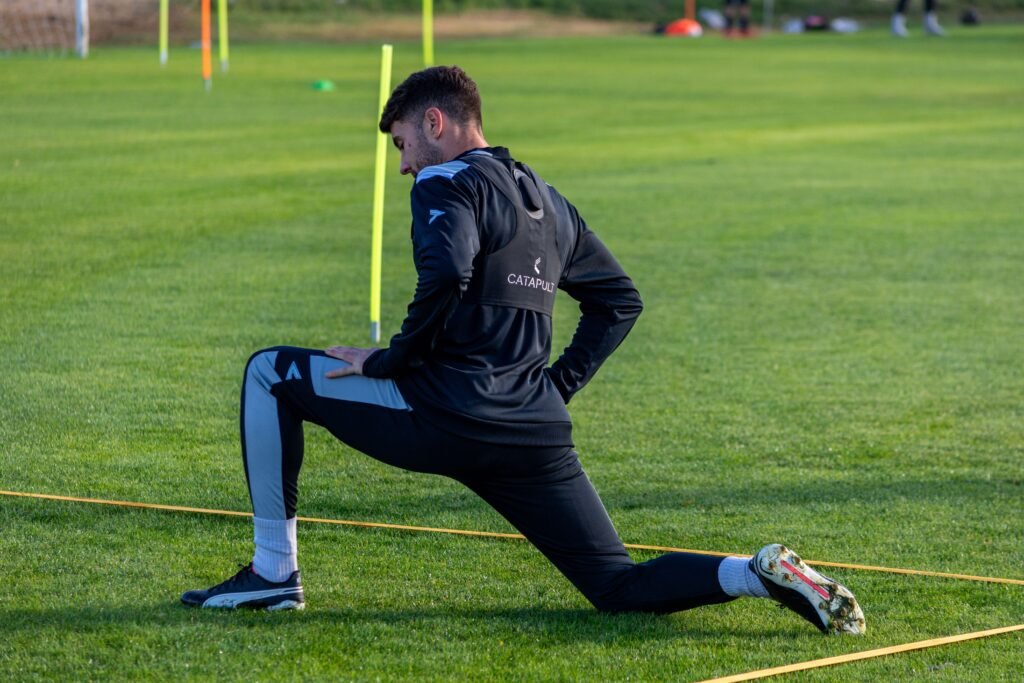
One of the biggest mistakes you can make with ACL rehabilitation is searching for a list of exercises and assuming that you can follow it regardless of where you are in your recovery.
The correct exercise at the wrong stage can be the wrong exercise.
Instead, think about what rehabilitation is trying to achieve.
Early stage
The focus may include:
- Knee movement
- Swelling management
- Quadriceps activation
- Basic mobility
- Walking
Strength stage
The focus shifts towards:
- Quadriceps strength
- Hamstring strength
- Glute strength
- Calf strength
- Single-leg control
Running stage
The focus becomes:
- Running mechanics
- Progressive loading
- Hopping
- Landing
- Balance
Football stage
The focus becomes:
- Acceleration
- Deceleration
- Cutting
- Agility
- Jumping
- Sport-specific movement
This progression is consistent with modern ACL rehabilitation approaches that favour criteria-based progression rather than simply following a rigid calendar.
Football-Specific ACL Recovery
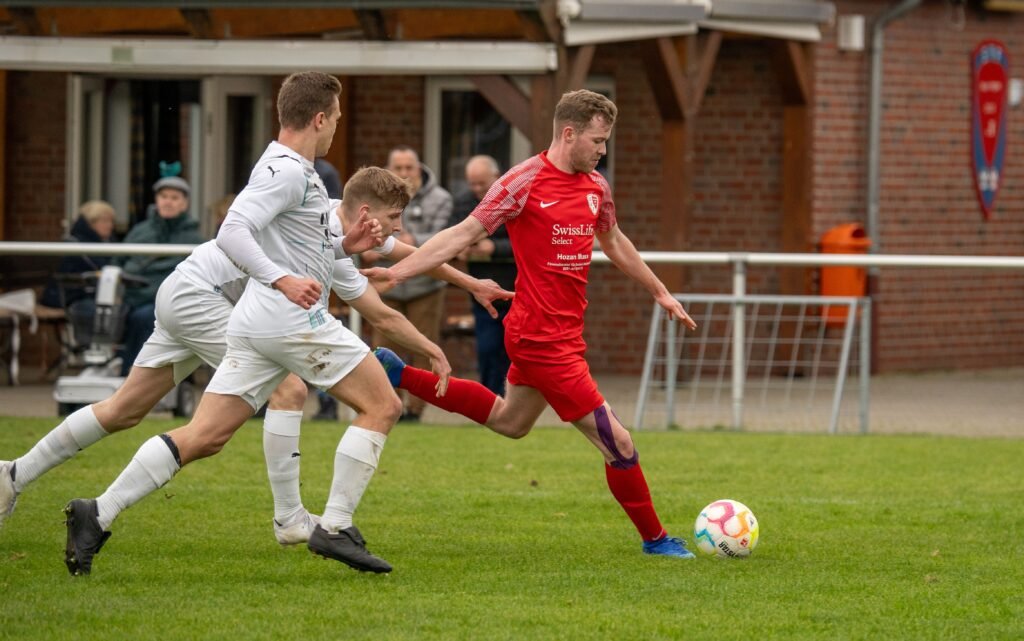
Football presents a particular challenge after an ACL rupture.
It’s not enough to be able to walk, jog or even complete a gym session.
A footballer needs to be able to repeatedly:
- Sprint
- Stop
- Change direction
- Jump
- Land
- React to another player
- Kick
- Challenge for the ball
- Move unpredictably
That’s why the final stages of rehabilitation need to become increasingly football-specific.
A player might feel perfectly comfortable jogging in a straight line but still not be ready to make a hard cut while reacting to an opponent.
Football readiness is a much higher bar than simply being pain-free.
When Can You Return to Football After a Ruptured ACL?
There is no universal date.
Some rehabilitation pathways describe return to sporting activity from around 9–12 months or later, while other clinical guidance allows progression based primarily on meeting specific criteria rather than a fixed timeline.
For some athletes, recovery can take considerably longer.
One NHS rehabilitation programme advises that the ACL graft can take 12–24 months to reach its greatest strength, while emphasising consultation with the surgeon or physiotherapist before returning to sport.
That doesn’t mean every footballer must automatically wait 24 months.
It demonstrates why a simple “ACL recovery = 9 months” rule is inadequate.
Your return should be based on your knee, your rehabilitation, your sport and your medical team’s assessment.
What Should a Footballer Be Able to Do Before Returning?
Rather than focusing exclusively on time, a footballer should work towards being able to demonstrate appropriate:
Strength
Particularly in the quadriceps and hamstrings.
Balance
The injured leg should demonstrate appropriate control compared with the other side.
Jumping and landing
You should be able to land and absorb force with good mechanics.
Running
You need to tolerate progressively faster running.
Change of direction
Football requires rapid cutting and directional changes.
Football-specific training
You should be able to complete increasingly demanding football activities before returning to competitive matches.
Psychological readiness
Confidence matters too.
Current ACL rehabilitation guidance specifically includes psychological readiness as part of return-to-sport decision making.
Don’t Ignore the Mental Side of ACL Recovery
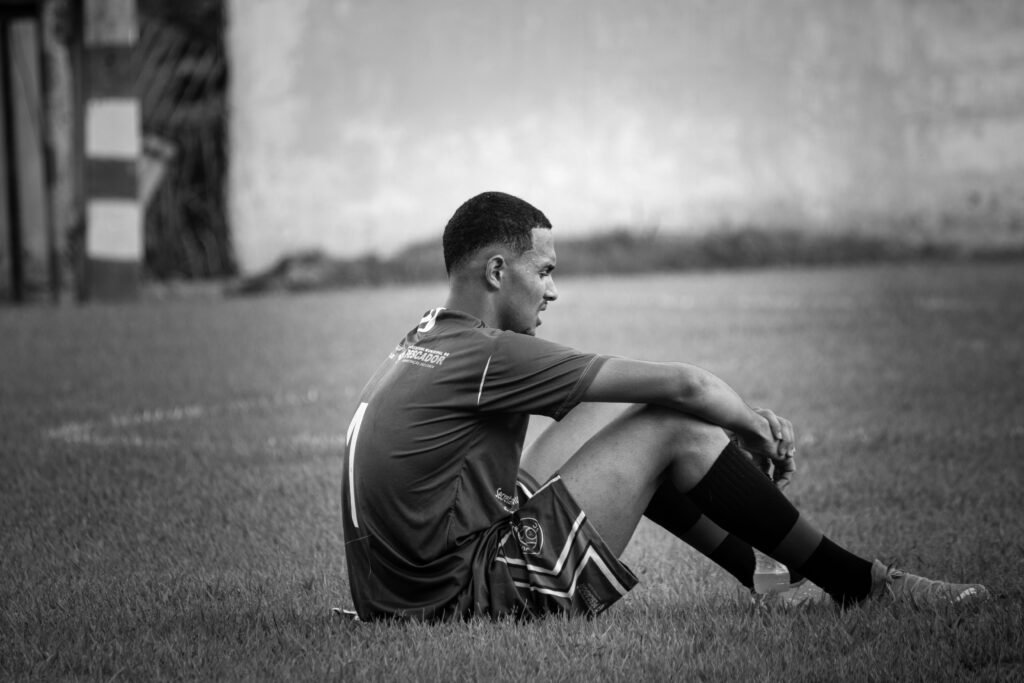
An ACL injury isn’t only physical.
You might eventually have the strength to return but still feel nervous about:
- Turning sharply
- Tackling
- Landing
- Sprinting
- Playing against opponents
- Trusting the injured knee
That’s normal.
Confidence shouldn’t mean ignoring fear and playing anyway.
Instead, confidence should be developed gradually through successful rehabilitation and progressively more demanding football-specific situations.
If you’re interested in this side of football performance, our guide [How to Gain Confidence in Football: A Science-Based Guide to Performing Under Pressure] is a natural related article.
Common Mistakes During ACL Recovery
Returning Because the Knee Feels Better
Pain reduction isn’t the same as complete recovery.
Following Someone Else’s Rehabilitation Programme
Your injury, surgery and progress may be completely different from another player’s.
Rushing Into Running
Running should be introduced when your rehabilitation team considers you ready.
Ignoring Strength Differences
You may feel strong while still having a meaningful deficit compared with your other leg.
Going Straight From Gym to Match
There should be a progression through running, agility and football-specific training.
Focusing Only on the Physical Side
Psychological readiness matters too.
Thinking Nine Months Automatically Means “Safe”
Nine months is not a magic switch.
A recent study supports criteria-based return decisions rather than relying solely on time.
When Should You Seek Medical Advice?
If you think you have suffered a ruptured ACL, seek professional assessment rather than attempting to diagnose yourself.
You should particularly seek medical advice following a significant knee injury involving:
- Sudden swelling
- Significant pain
- Difficulty bearing weight
- Instability
- A popping sensation
- Loss of normal knee movement
If you’ve already been diagnosed with an ACL rupture, speak with your orthopaedic specialist or physiotherapist about your individual treatment and rehabilitation pathway.
And if you develop concerning symptoms during recovery — such as significant worsening pain, swelling, wound problems or other unusual symptoms — contact your healthcare team.
Can Products Help ACL Recovery?
Products can potentially be useful during rehabilitation, but no knee brace, compression sleeve, resistance band or recovery gadget repairs a ruptured ACL.
The important things are appropriate medical care and structured rehabilitation.
That said, equipment can sometimes make rehabilitation more convenient.
For example, depending on your stage of recovery and the advice of your physiotherapist, products such as:
- Resistance bands
- Exercise mats
- Balance equipment
- Foam rollers
- Recovery/rehabilitation accessories
may have a role.
Best ACL Recovery Products: Knee Supports, Rehab Equipment & Recovery Tools
See Link:
FAQs
Can a ruptured ACL heal on its own?
The outcome varies depending on the injury and individual circumstances. Some people can function without reconstruction, while others experience instability or require surgery. A healthcare professional should assess the injury and discuss appropriate treatment options.
How long does a ruptured ACL take to recover?
Recovery varies considerably. After ACL reconstruction, returning to sport can take many months and often around a year or longer. Return should be based on rehabilitation progress and objective criteria rather than a fixed date.
Can I play football with a ruptured ACL?
You shouldn’t assume that you can safely play football simply because you can walk or jog. Football involves pivoting, cutting and rapid changes of direction, which place substantial demands on the knee. Get appropriate medical advice.
When can I start running after ACL surgery?
The timing varies. Some rehabilitation pathways introduce jogging around three months, provided specific criteria have been met, while others may progress differently. Your physiotherapist should determine when you’re ready.
When can I return to football after ACL reconstruction?
There isn’t one guaranteed date. Many athletes return around 9–12 months or later, but return should depend on strength, movement quality, sport-specific performance and psychological readiness rather than the calendar alone.
What exercises are good for ACL recovery?
Exercises change throughout rehabilitation. Early work may focus on movement and quadriceps activation, followed by progressive strength, balance, running, jumping and eventually agility. Your physiotherapist should prescribe and progress your exercises.
Do I need an ACL brace?
Not everyone with an ACL injury needs the same type of brace. Whether one is appropriate depends on your injury, treatment and rehabilitation plan. Discuss this with your healthcare professional rather than choosing a brace solely based on online recommendations.
Can you return to football after a ruptured ACL?
Yes, many athletes return to football after ACL reconstruction and rehabilitation. However, returning to the same level isn’t guaranteed, and the process should be gradual and criteria-based.
Related Articles
Recovery
Exercises for Patellar Tendonitis: A Footballer’s Guide to Recovery
MCL Strain Recovery: A Footballer’s Guide
Performance
Football Agility Drills: 10 Exercises to Improve Speed & Change of Direction
Strength Training for Football The Complete Guide to Getting Stronger Without Losing Speed
Mental performance
How to Gain Confidence in Football: A Science-Based Guide to Performing Under Pressure
Future commercial article
Best ACL Recovery Products: Knee Supports, Rehab Equipment & Recovery Tools
Conclusion
A ruptured ACL is a serious football injury, but it doesn’t automatically mean the end of your time on the pitch.
Recovery is a process.
First comes managing the injury and restoring normal movement. Then comes rebuilding strength and control, followed by running, jumping, agility and eventually football-specific training.
The biggest mistake is treating recovery as a countdown.
Six months doesn’t automatically mean you’re ready. Nine months doesn’t automatically mean you’re ready.
Your return should depend on whether you’ve regained the strength, movement, control, confidence and football-specific ability required for the demands of the game. Current ACL rehabilitation guidance strongly supports this criteria-based approach.
If you’ve suffered a suspected ACL rupture or are currently recovering from one, use this article as a source of general information — not as a substitute for assessment and rehabilitation from a qualified healthcare professional.